How to Choose a Painting Contractor in Miami
What to look for — and what to walk away from — when hiring a painting contractor in Miami. Licensing, fixed quotes, prep quality, and the questions that reveal a contractor's standards.
By OOH! Editorial Team
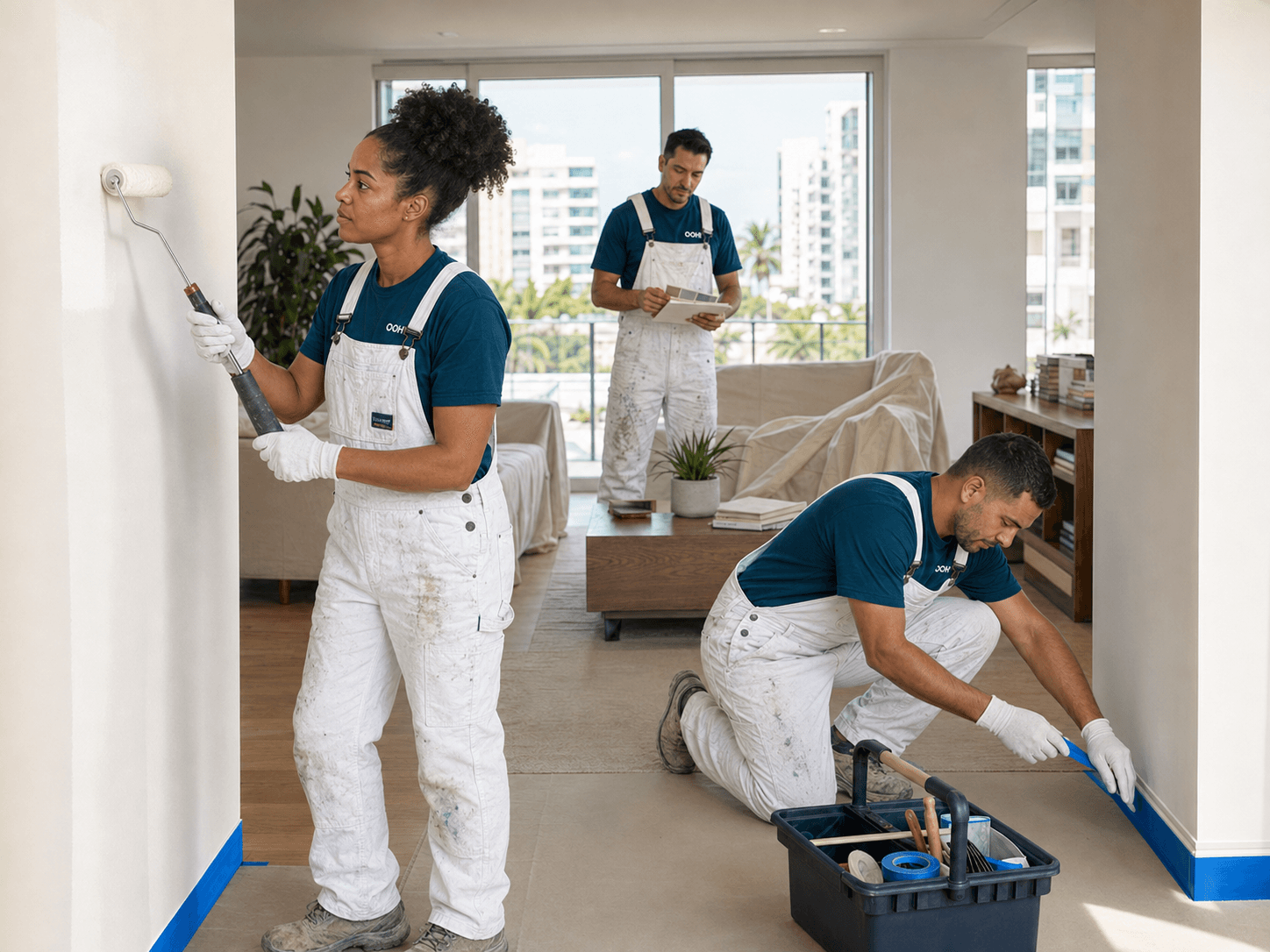
Finding a reliable painting contractor in Miami isn't difficult — if you know what to look for. The market has plenty of skilled professionals, but also contractors who cut corners on prep, use inferior materials, or give prices that shift once work begins. This guide walks through how to screen, evaluate, and choose a painter who will deliver what they promise.
Licensing and insurance — the baseline
In Florida, painting contractors working on projects above a certain dollar threshold are required to be licensed with the state or county. Beyond the legal requirement, licensing matters because it establishes accountability — licensed contractors can be reported to a regulatory body if work goes wrong. Ask for a license number and verify it at the Florida Department of Business and Professional Regulation (dbpr.state.fl.us).
Insurance is equally important. At minimum, a contractor should carry general liability insurance — which covers damage to your property — and workers' compensation if they employ people. Ask for certificates of insurance before work begins. An unlicensed or uninsured contractor working on your home can expose you to liability if someone is injured on-site.
Fixed price vs. open-ended billing
This is the most consequential difference between contractors. A fixed quote means the price is agreed in writing before work starts and doesn't change unless you add scope. An open-ended or time-and-materials arrangement means the final number depends on how long the job takes — which the contractor controls.
Fixed-price contracts protect you. They require the contractor to accurately scope the project before committing to a number, which incentivizes thorough evaluation up front. If prep takes longer than expected, that's the contractor's problem — not yours.
Time-and-materials arrangements can be reasonable in highly unpredictable situations (extensive damage, unknown conditions), but they should be the exception rather than the default for straightforward residential painting.
The in-person evaluation
A contractor who quotes without visiting the site is guessing. The in-person evaluation is where scope gets defined, surface conditions get assessed, and the final price gets set. A quality evaluation should cover:
- Every surface to be painted — not just a general walkthrough
- Surface condition: peeling, staining, damage, previous repairs
- Prep requirements: what needs to be done before paint can go on
- Color change assessment: how many coats will be needed
- Logistics: access, furniture to move, areas to protect
- Product selection: what paint is appropriate for each surface and environment
In Miami's climate, this evaluation should include attention to moisture indicators — peeling at baseboards, bubbling near windows, or discoloration that suggests water intrusion behind the surface. These are signs of underlying issues that paint alone won't fix.
Who actually does the work
Not every contractor who estimates your project is the person who will paint it. Some companies operate as general contractors who subcontract the actual work — meaning the crew that shows up may have no relationship to the person who evaluated your home. Others use a rotating pool of day laborers rather than consistent employees.
This isn't automatically a problem, but it's worth understanding before you sign. Ask: Are the people doing the work employees of your company? Will the same crew be here throughout the project? Who do I contact if I have questions once work begins?
Coordinated crews — where multiple trained painters work in parallel on a single project — are particularly effective for larger scopes. They reduce total time on-site, which matters if you're living in the space during the project.
Prep quality signals
Paint failure almost always comes from poor preparation, not poor paint. The quality of the prep work is the best predictor of how long your paint job will last. During your evaluation and when reviewing a quote, watch for these signals:
- Is prep explicitly included in the quote? Cleaning, sanding, caulking, patching should be listed — not assumed
- Is primer included? New drywall, stained surfaces, and significant color changes require primer
- How is furniture handled? Floors and furniture should be protected with drop cloths and plastic before any paint is applied
- What happens with hardware? Door knobs, outlet covers, and switch plates should be removed or carefully masked — not just painted around
Questions to ask before hiring
- Are you licensed and insured in Florida? Can I see your certificate of insurance?
- Is this a fixed-price quote, or can the cost change?
- What prep is included — cleaning, patching, sanding, caulking?
- What paint brand and product line will you use?
- How many coats are included?
- Who will actually be doing the work — your employees or subcontractors?
- What is your process if I notice something that needs touch-up after completion?
- Can you share photos of recent projects similar in scope to mine?
- What is your payment structure?
A contractor who answers these questions clearly, in writing if asked, is demonstrating the kind of accountability that correlates with quality work.
Red flags to walk away from
- Quote over the phone, without seeing the space — this is a guess, not a quote
- Large upfront cash deposit demanded before work starts — reputable contractors take a reasonable deposit, not a majority of the job upfront
- No written contract — verbal agreements are unenforceable
- Reluctance to show proof of insurance — this is a standard request; hesitation is a signal
- Unusually low bid — below-market prices typically reflect inferior materials, minimal prep, or a plan to raise the number mid-project
- Pressure to decide immediately — scarcity tactics don't belong in contractor selection
- No online presence or verifiable reviews — a contractor with no track record is a risk
The best painting contractors in Miami don't need high-pressure tactics or vague pricing because their work speaks for itself. Take the time to evaluate, ask the questions above, and compare what's actually included — not just the bottom line.
OOH! Editorial Team
Painting professionals in the Miami–Fort Lauderdale area